
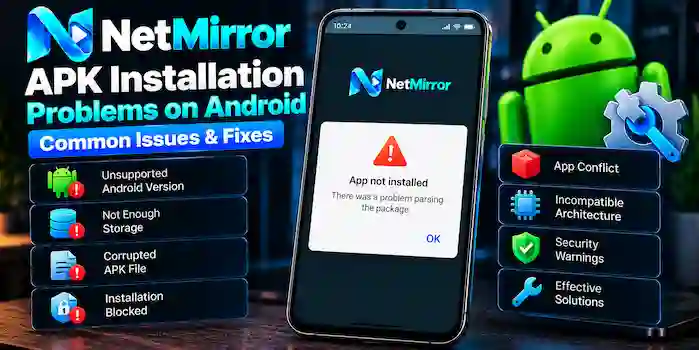
Installing an APK on Android is usually straightforward, but sometimes the process stops with an error or the application does not work after installation. If you are facing NetMirror APK installation problems, identifying the exact cause can make troubleshooting much easier.
This guide covers common installation issues and practical checks you can perform before trying the APK again.
Common NetMirror APK Installation Problems
NetMirror may fail to install for several reasons, including:
- Unsupported Android version
- Insufficient storage
- Corrupted APK file
- Installation restrictions
- Existing app conflicts
- Incompatible APK architecture
- Security-related blocks
The correct solution depends on the specific error shown by Android.
1. Check Your Android Version
The first thing to check is your phone’s Android version.
Open:
Settings → About Phone → Android Version
The exact menu can vary between manufacturers.
Compare your Android version with the requirements of the NetMirror APK you are trying to install. An APK designed for a different Android environment may not install correctly.
2. Make Sure You Have Enough Storage
Low storage is another common cause of installation failures.
Go to:
Settings → Storage
Check how much free space is available. If your phone is nearly full, remove unnecessary files or applications and then try the installation again.
Remember that Android may need additional temporary space during installation.
3. Check the APK File
A damaged or incomplete APK can cause installation errors.
Before trying again, check:
- File name
- File extension
- File size
- Download source
- Whether the download completed successfully
If the download was interrupted, obtain a fresh copy from a source you trust rather than repeatedly attempting to install the same damaged file.
4. Check Installation Permissions
Android can restrict APK installation from sources outside its official app store.
If you see a message indicating that installation from the current source is not allowed, Android may provide an option to change the relevant setting for the browser or file manager being used.
Only allow installation from a source you trust. You should not disable broader Android security protections just to force an APK to install.
5. Check for an Existing NetMirror Installation
If another NetMirror version is already installed, the new APK may conflict with it.
Open:
Settings → Apps → NetMirror
Check the currently installed version.
If the new APK is intended to replace an existing installation but uses different package or signing information, Android may reject the update.
Be careful when uninstalling an existing version because removing an app can also remove its locally stored data.
6. Check APK Architecture
Android applications can be built for different processor architectures.
Common architectures include:
- ARM64
- ARM
- x86
- x86_64
If the APK is not compatible with your phone’s architecture, installation may fail or the application may not work correctly afterward.
When the APK source provides architecture information, compare it with your device requirements before installation.
7. Look at the Exact Android Error
Don’t ignore the error message shown during installation.
Messages such as an incompatible package, parsing problem, insufficient storage, or blocked installation can point toward different causes.
Write down the exact message before searching for a solution. This is usually more useful than repeatedly reinstalling the same APK.
8. Restart Your Android Phone
A simple restart can sometimes resolve temporary Android system problems.
After restarting:
- Check available storage.
- Locate the APK again.
- Open the file.
- Follow the installation prompts.
- Pay attention to any new error message.
If the same error appears, use it to identify the underlying issue instead of repeatedly restarting.
9. Keep Android Security Features Enabled
Security warnings should be taken seriously.
If Android identifies an APK as potentially unsafe or displays another security warning, stop and investigate the file and its source.
Do not bypass a warning simply because the application will not install without doing so. A different, trustworthy source or compatible release may be a better solution.
10. Try a Compatible APK Version
Sometimes the problem is simply that the particular NetMirror release does not match your device.
Check:
- Android version requirements
- Device architecture
- APK version
- Application requirements
- Existing NetMirror version
If your phone supports another compatible release, using the appropriate version may resolve the installation issue.
NetMirror APK Installation Troubleshooting Checklist
| Problem | What to Check |
| APK won’t install | Android compatibility and file integrity |
| Storage error | Available device storage |
| Installation blocked | Relevant Android installation permission |
| Package conflict | Existing NetMirror installation |
| Parsing/package error | APK compatibility or damaged file |
| App crashes after installation | Android version and architecture |
| Security warning | APK source and file authenticity |
What to Do After NetMirror Installs
If the APK installs successfully but NetMirror does not open, the issue is no longer an installation problem.
Check:
- Android compatibility
- Application permissions
- Available storage
- Network connection
- Existing application data
- Whether the installed version is supported
If the application repeatedly crashes, avoid installing random APK variants one after another. Identify the compatibility issue first.
Final Thoughts
NetMirror APK installation problems can usually be traced to compatibility, storage, APK integrity, installation permissions, or conflicts with an existing version.
Start with the basics: check your Android version, free storage, APK source, and exact error message. If the file is incompatible or appears suspicious, don’t force the installation. Choosing a compatible and trustworthy APK is safer and usually more effective than bypassing Android’s protections.